Galway Today

When Does a Logo Stop Belonging to Its Designer and Start Belonging to a City?

Galway City — 17 September 2026
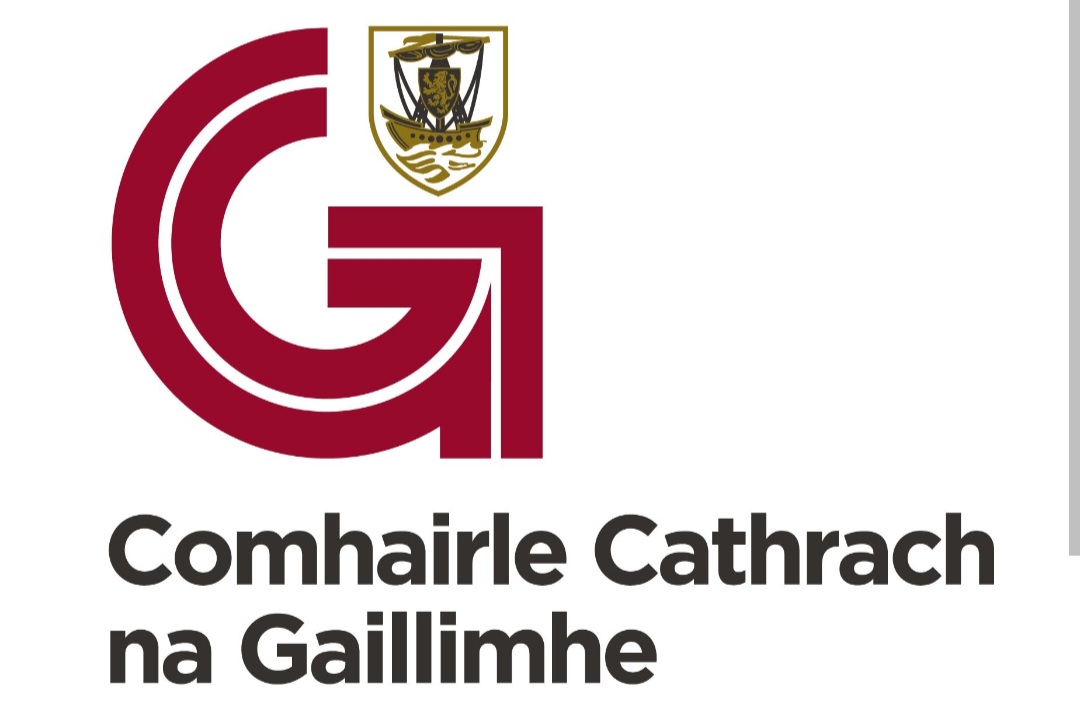
The familiar Galway City Council G logo

Galway City's familiar G

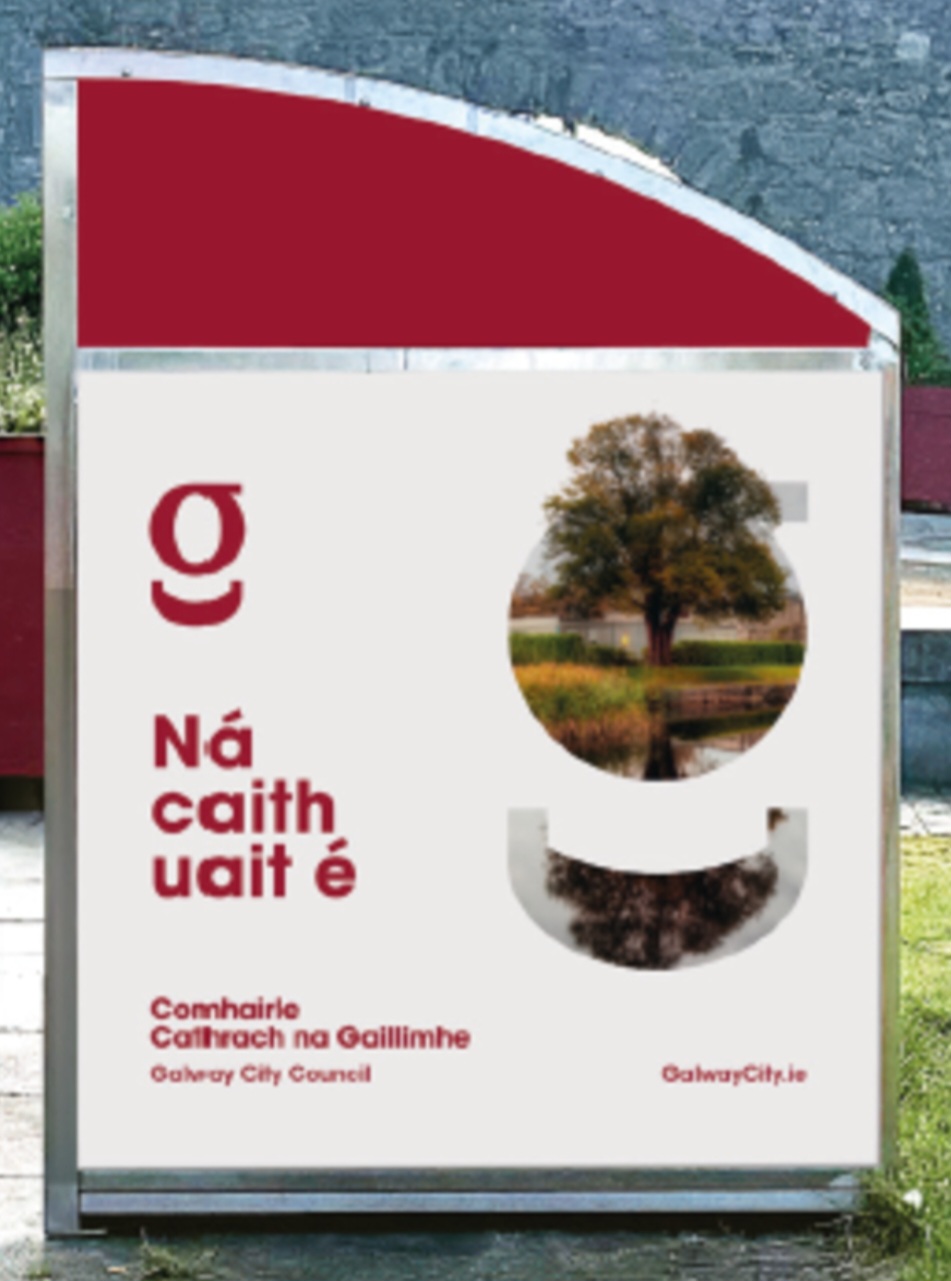
The new Galway City Council lower-case g visual identity

Galway City's new visual identity

Galway has a new look.

Galway City Council has unveiled a new visual identity built around a lower-case g, replacing the familiar capital G that has been part of the city's visual landscape for decades.

And I have a problem with it.

That surprises me, because I am usually all for change.

Cities should change. Buildings change. Streets change. Art changes. The way we communicate changes. Galway itself has never stood still.

But sometimes modernisation isn't resisted because people dislike change.

Sometimes the thing being replaced has already acquired cultural value.

The familiar Galway G can trace its beginnings back to 1984, when its first iteration was created by Galway designer Jimmy Conneelly as part of the city's quincentenary celebrations.

That means generations of people have grown up seeing it.

It has appeared on Council vehicles, signs, buildings, bins, documents and countless other pieces of the everyday Galway landscape.

After more than forty years, something interesting happens to a design like that.

You stop noticing that somebody designed it.

It simply becomes part of the place.

And that raises a question: When does a logo stop belonging to its designer and start belonging to a city?

The new design hasn't appeared without thought behind it.

Galway City Council says the lower-case g takes inspiration from the hull of the ship represented in Galway's coat of arms, while its form also draws from seanchló, the historic style of Irish script.

The familiar maroon remains. Blue has been introduced to represent the River Corrib. The Irish-language name, Comhairle Cathrach na Gaillimhe, is given greater prominence, and the city's coat of arms has not been abolished; it remains part of the Council's wider visual identity.

There are ideas there that I can appreciate.

But appreciating the thinking behind a new design and feeling that it should replace an old one are two different things.

Perhaps that is what makes this change particularly interesting.

The old G has had something the new g cannot possibly have on its first day:

Time.

Time to become familiar.

Time to appear in people's photographs without being the subject of the photograph.

Time to sit quietly on the streets of Galway until nobody really thinks of it as branding anymore.

That cannot be manufactured by a design brief.

It can only happen by living with a symbol.

The Council says the change is about more than a logo. Its €28,000 branding project followed a review of how the organisation presents the many services it provides, with the intention of creating a more consistent and recognisable identity.

That is a legitimate conversation for a city to have.

But perhaps another conversation should happen alongside it.

Not simply:

Is the new logo good or bad?

But:

What exactly are we replacing?

Because if Galway's old G were merely an outdated piece of corporate branding, changing it would be relatively straightforward.

If, however, forty-two years of Galway life have transformed it into something people recognise as part of the city itself, then changing it becomes something more complicated.

The new g may eventually acquire its own history.

People may grow accustomed to it. Children growing up in Galway today may one day recognise it as instinctively as previous generations recognise the old G.

That possibility should be allowed too.

But today, on the day the new identity is officially unveiled, the old G has something its replacement has yet to earn.

Galway has already lived with it.

And perhaps that is why changing a city's identity can never be quite the same thing as changing a company's logo.

A company can own its branding.

A city eventually shares its symbols with the people who live among them.

Bam Artiste
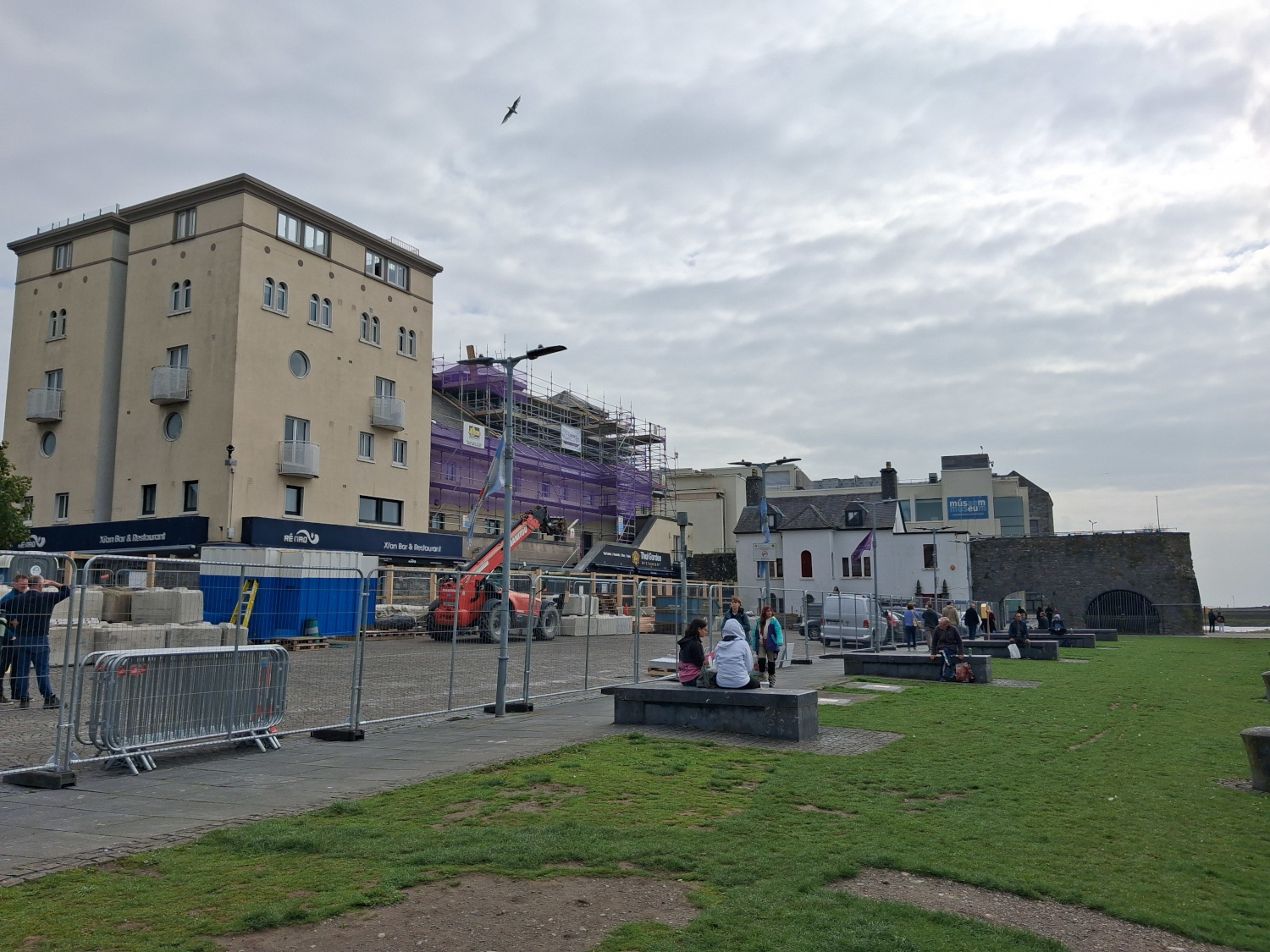
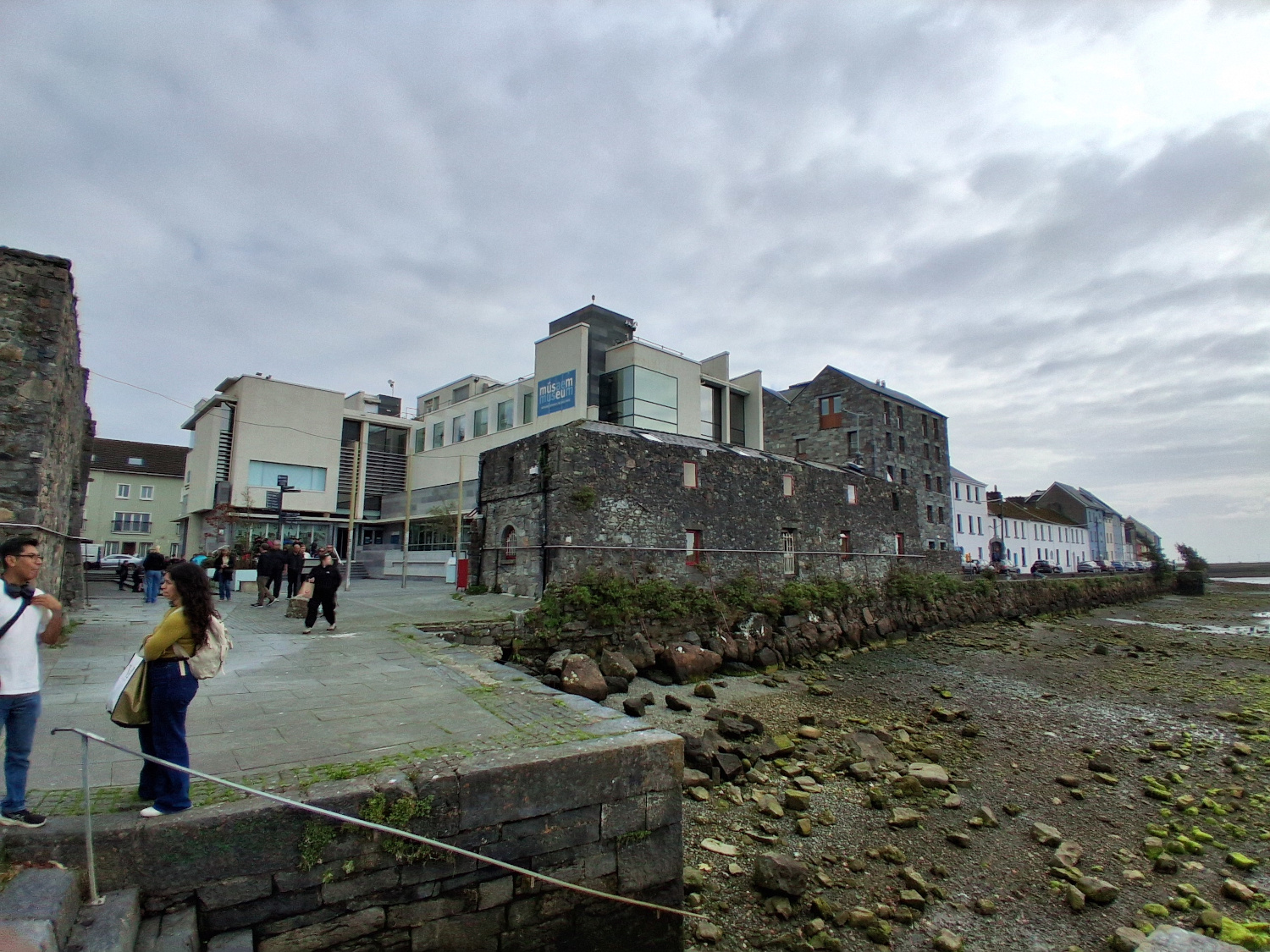
Construction works beside Comerford House at Spanish Arch, Galway City Galway City Museum beside Spanish Arch, Galway City

Galway Now

The Old Museum Meets the New

Spanish Arch, Galway City — September 2026

I walked down to Spanish Arch to see for myself what is happening around Galway City Museum. The barriers are up, construction equipment is on site, and a familiar part of Galway is beginning another transformation.

The two photographs above tell an important part of the story. The small white building beside Spanish Arch is Comerford House, the former home of Galway City Museum. In 2007, the purpose-built Galway City Museum opened nearby, becoming the museum Galway knows today.

Now the old and the new are being brought together.

A major redevelopment of Galway City Museum is underway. The project includes a new three-storey extension designed to connect the existing museum with historic Comerford House, creating a larger integrated museum complex at Spanish Arch.

Standing there, however, the interesting thing wasn't an architectural drawing of what the finished development might eventually look like.

It was seeing the beginning.

Fencing now cuts across part of the familiar open space. Construction materials and machinery occupy areas where people normally walk, while visitors continue to sit, talk and move through Spanish Arch around the work.

One photograph looks towards Comerford House and the construction area. The other looks towards the larger museum that replaced it. For years these buildings represented two different periods in the life of Galway City Museum. The redevelopment now underway will bring those periods together.

These photographs aren't of the finished redevelopment. They record what this part of Galway looked like while the transformation was just beginning.

Photographs and observation: Bam Artiste

Galway Now

A Galway Park That Exists on Paper Before It Exists on the Ground

Kingston, Galway City — September 2026

Somewhere in Galway there is a park that people cannot walk through yet.

For now, much of it exists in plans, drawings and decisions about what this part of the city could eventually become.

But this week those plans moved another step towards becoming a real place.

Planning permission has been granted for the redevelopment of Kingston Park and Millers Lane Park, with €7.5 million in funding also announced to begin the first phase at Kingston.

The wider project proposes new sports facilities, community spaces, walking and cycling connections, biodiversity improvements and new areas of public open space.

Eventually people may walk through it, children may play there and somebody may sit outside a café without giving much thought to how the place began.

But right now is different.

Right now Galway gets to see something that cities don't always stop to notice:

the moment when a future piece of the city exists more clearly on paper than it does on the ground.

GalwayCityNow

Galway Now

While Galway Rebuilds Their Home, Someone Has to Feed the Squirrels

Merlin Woods, Galway City — September 2026

There is a much bigger story unfolding in Merlin Woods.

Storm Éowyn badly damaged parts of the woodland, particularly areas containing Norway spruce, and work is now underway as Galway City Council prepares to restore damaged areas with native woodland.

But hidden inside that much larger story is a smaller one.

The squirrels still have to live there.

Merlin Woods is home to a population of native red squirrels, and while damaged trees are being cleared and the woodland begins what could be a long process of recovery, their habitat is changing around them.

So squirrel feeders are being installed.

The supplementary feeding programme is intended to support the red squirrels while the woodland is restored. Recent reports from a Galway City Council meeting suggest that support could continue for eight to ten years.

That's the part of the story that caught my attention.

We often talk about rebuilding a place as though the only question is what eventually replaces what was lost. But between the damage and the recovery there are creatures that still have to make a life there.

New trees can be planted.

A woodland can grow again.

But while Galway waits for that new woodland to become a forest, somebody has to remember the squirrels already living in it.

GalwayCityNow

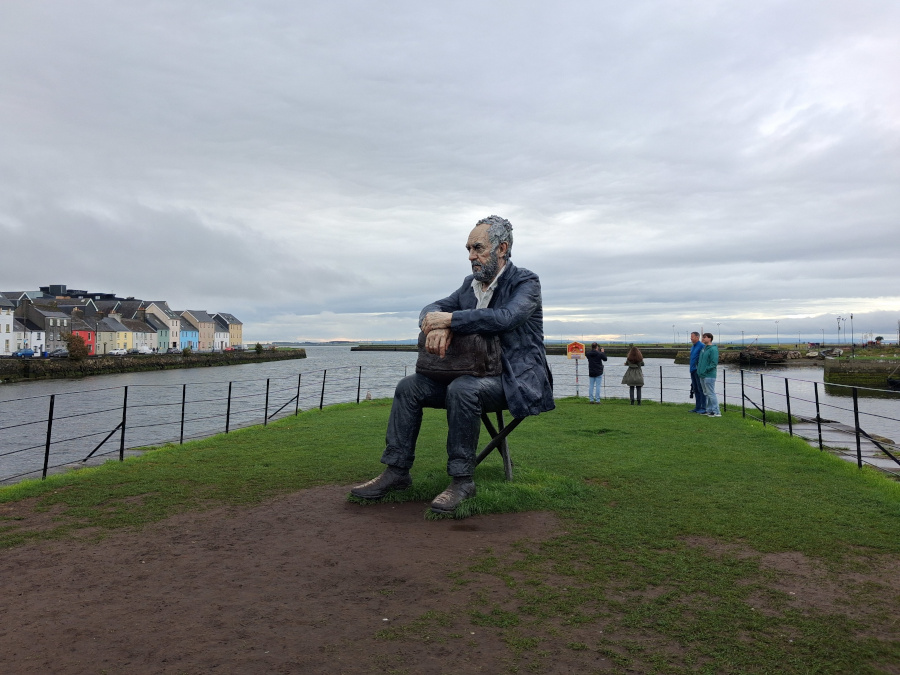
Sean Henry's Seated Figure beside the Claddagh Basin in Galway City

Galway Now

Now We Know Why He's Still Sitting There

Middle Arch, Galway City — September 2026

A few days ago I went walking around Galway looking for something worth stopping to notice.

I found a man sitting beside the Corrib.

Not an ordinary man, of course, but Sean Henry's monumental sculpture Seated Figure, still occupying his place at Middle Arch months after arriving in Galway for the International Arts Festival.

That was what caught my attention.

When the sculpture arrived during the summer, it was expected to remain in Galway until the festival ended in late July.

But when I photographed him in September, he was still sitting there.

Now we know why.

Galway International Arts Festival has confirmed that Seated Figure, along with Sean Henry's The Wanderer in Eyre Square, remained in the city so that people could see them through Culture Night on Friday, 18 September.

Culture Night is being presented as the final opportunity to encounter the two works before they leave Galway.

So the question raised when I stood beside the Corrib a few days ago has an answer.

He didn't simply stay behind after the festival. His visit to Galway had been extended.

And now the Galway visitor who stayed a little longer than expected is finally preparing to leave.

Photograph and observation: Bam Artiste

Middle Arch, Claddagh — 14 September 2026, Galway City

Galway Seen

He's Still Sitting There

Middle Arch, Claddagh — 14 September 2026

I went walking around Galway this morning looking for something worth stopping to notice.

And there he was.

Sitting beside the Corrib, arms resting across his satchel, apparently watching Galway go by.

He is Seated Figure, a monumental sculpture by British artist Sean Henry. The work was installed at Middle Arch in June as part of the build-up to Galway International Arts Festival 2026 and Henry's exhibition, Presence.

When the sculpture arrived, it was reported that it would remain here until the festival ended in late July.

It is now September.

And he's still sitting there.

Maybe that's what caught my attention more than anything else. Festivals arrive, transform Galway for a few weeks, and then disappear. Posters come down. Venues return to normal. Crowds move on.

But occasionally something seems to linger behind.

Today people walked past him, stopped beside him and looked out across the water. Meanwhile he remained exactly where I found him — a silent visitor who, at least for now, appears to have stayed in Galway a little longer than expected... no more than most of us.

Photograph and observation: Bam Artiste

Middle Arch, Claddagh — 14 September 2026, Galway City

Galway Now

Investigating Tomorrow's Floods — In Today's Rain

Raven Terrace, Galway City — 14 September 2026

It had been raining in Galway all day when I walked down to Raven Terrace.

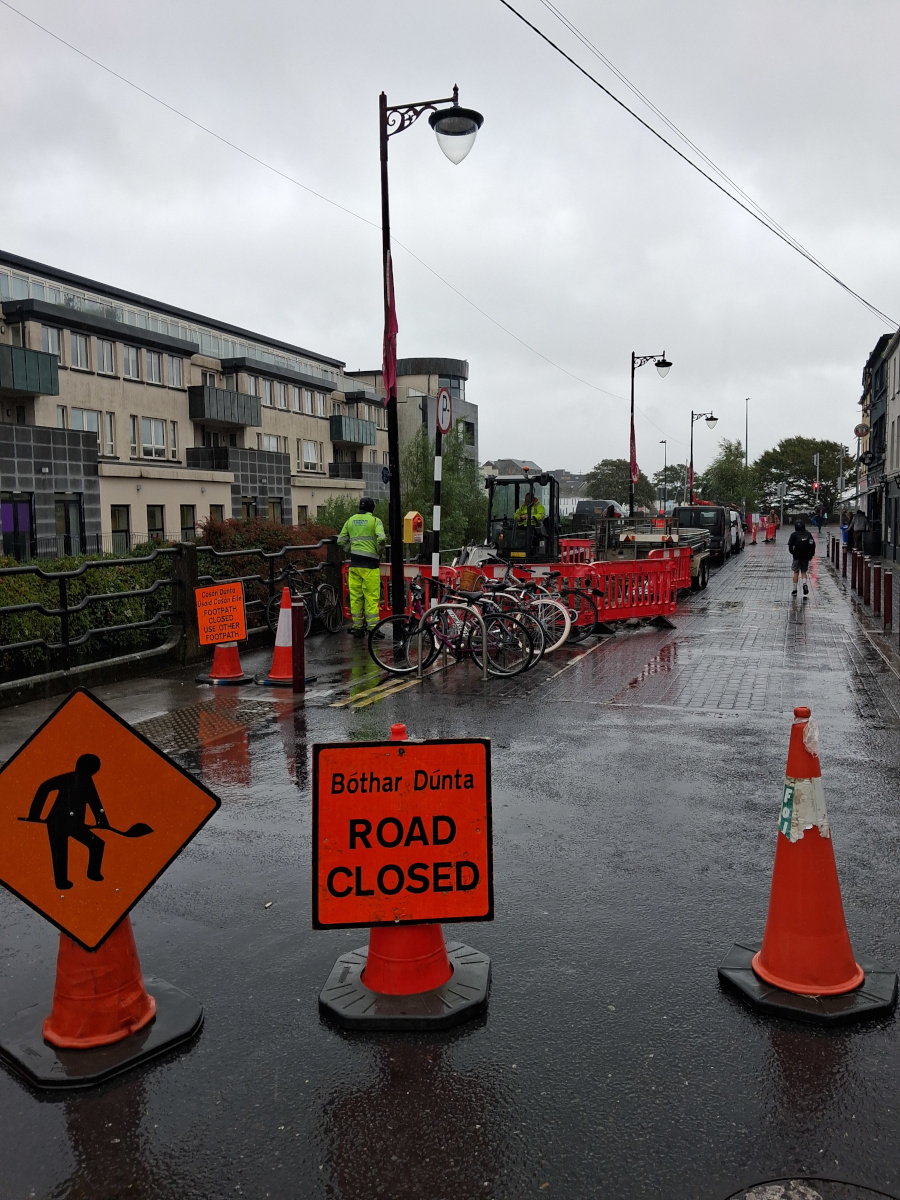
The road was closed. Red barriers stretched across the wet street, machinery occupied part of the roadway and workers in rain gear continued working while the rain came down around them.

There was a certain irony in what I was looking at.

The work taking place at Raven Terrace is part of site investigations connected with plans for flood relief in Galway — preparations intended to help the city deal with water in the future.

And here they were doing it in today's rain.

Galway City Council announced the temporary closure of Raven Terrace from 14 to 18 September to allow site investigation works for a flood relief system to be carried out.

Standing there made the official description feel much less abstract. The road surface was shining with rain. Water ran along the street. Workers moved between the barriers and equipment while pedestrians made their way around the works beneath umbrellas and hoods.

One of the workers noticed me taking photographs and, despite working outside in the rain, looked across and gave me a thumbs-up.

That small moment somehow suited the scene.

Flood protection is something usually discussed in plans, reports and future tense. But today, on Raven Terrace, part of that preparation was happening in front of me — barriers up, machinery working and Galway rain falling on everybody involved.

Photograph and observation: Bam Artiste

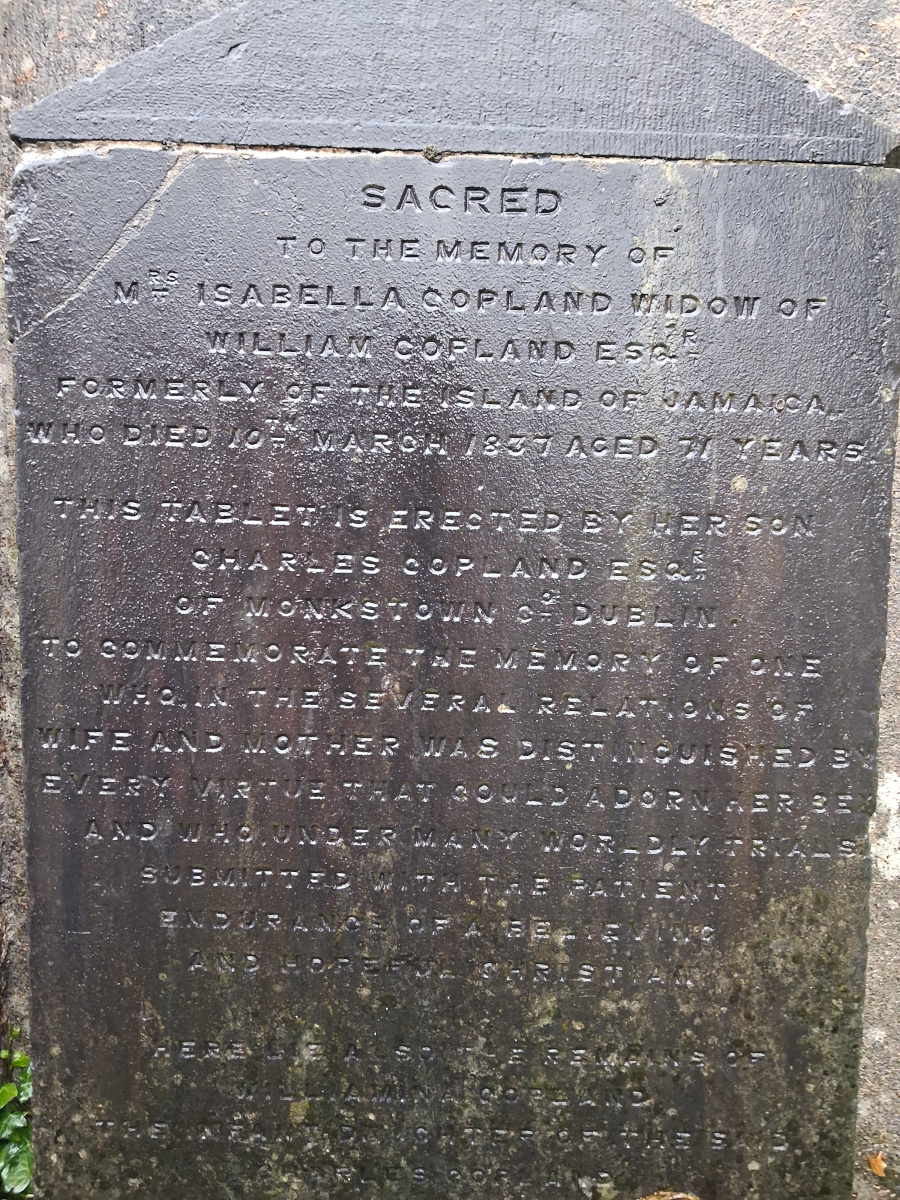
Memorial to Isabella Copland at St Nicholas' Collegiate Church in Galway City

Bam's Galway

I Went Looking for Galway — And Found Jamaica

St Nicholas' Collegiate Church, Galway City — 14 September 2026

I wasn't looking for Jamaica.

I was walking through Galway City when I wandered into the grounds of St Nicholas' Collegiate Church and began looking at some of the old memorials.

Then three words caught my attention.

“Island of Jamaica.”

The weathered memorial is dedicated to Mrs Isabella Copland, widow of William Copland, and describes her as formerly of the Island of Jamaica. She died on 10 March 1837, aged 71.

I stopped.

Jamaica is where I came from. Galway is where I now live. And here, in the middle of the city, I had unexpectedly stumbled across a connection between the two.

I don't know Isabella Copland's full story, or exactly what brought her from Jamaica into the history of Galway. The stone itself raises more questions than it answers.

But perhaps that is part of what makes walking through an old city interesting. Sometimes you go looking for Galway and find something you never expected to be looking for at all.

Photograph and observation: Bam Artiste

Living Galway

Galway Before Galway Wakes Up

Galway City Centre

I've seen Galway at an hour when much of the city is still asleep.

Around 5:00 in the morning, before the shops open and before most people begin making their way into the city centre, another working day has already begun.

Galway City Council cleaning crews are out on the streets. Sweepers move through the city centre while streets are washed and yesterday's dirt is cleared away before another day begins.

At that hour Galway feels like a different place. The streets that will later fill with shoppers, workers, visitors, musicians and delivery vehicles are quieter, while a small number of people are already working to prepare them.

Most of us encounter the result without ever seeing the work.

By the time Galway wakes up, part of somebody else's working day has already happened.

Observation: Bam Artiste

Advertisement

ROOTS Coffee Bistro

Coffee, breakfast, lunch and a place to meet in the heart of Galway City.

Shop Street, Galway City

Advertisement

OPUS II

Musical instruments, traditional Irish instruments, pianos, guitars, music books and accessories. Serving Galway's musicians since 2001.

4 High Street, Galway City

Advertisement

Warmth & Water Plumbing Services Ltd

Heating, plumbing, services and repairs. Reliable. Professional. Local.

Darren Conneely
Tel: 087 761 7475
Email: warmthandwater365@gmail.com

Serving Galway